After the Apple 2 and NES, I decided to embark on my next emulator project: a PC XT, which I named “Dos Ex Machina” (“dos ex” for short).

I’ve wanted to become more familiar with the 808x family for a long time and so far, this has been a great learning experience, not just for this processor but also learning more about MS-DOS, which is basically the operating system that ended up defining several decades of computer use.

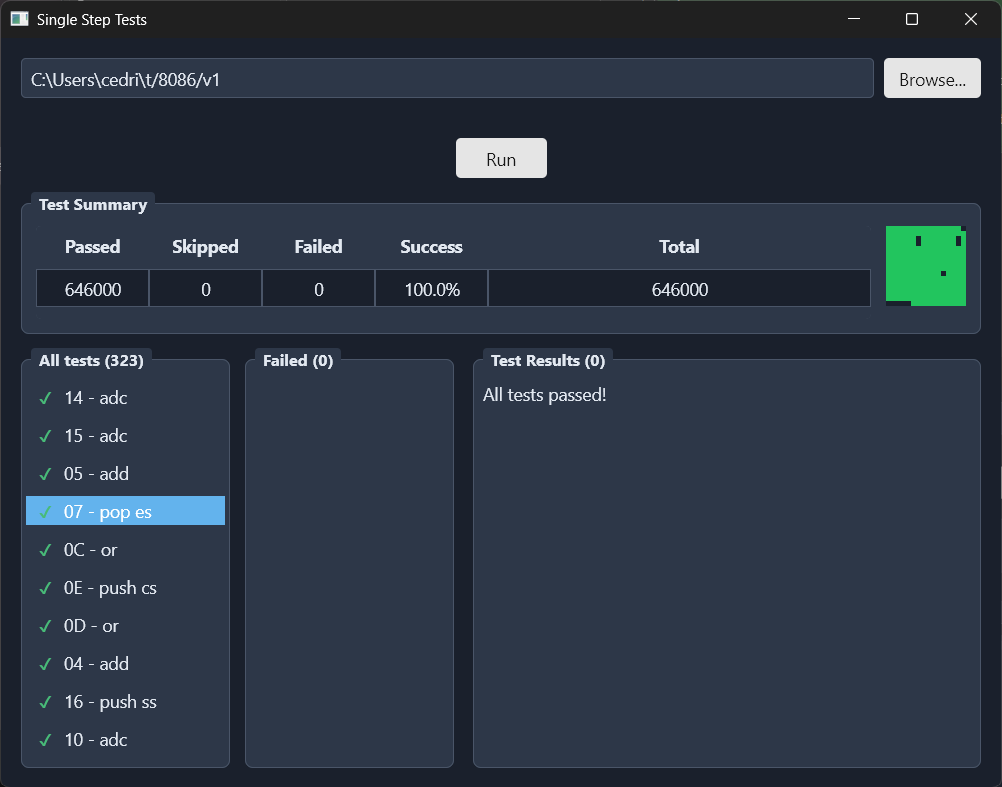
The first task was obviously to implement the processor, and thanks to the amazing Single-Step Tests, I was able to build an 8086 implementation that passed all the tests fairly quickly. It was also my first exposure to the very different operations and addressing modes that the 8086 offers compared to the 6502.
Pic 1

The Single Step Tests for 8086

Then I tackled the emulator itself, with the next milestone being able to boot an MS-DOS disk.

Basic boot

The process here is no different than any computer booting: first read the boot sector (512 bytes on cylinder 0, sector 0), run it, implement the BIOS operations it needs, which are mostly limited to loading more cylinders from the disk and then transferring control there.

This was my first exposure to the way that the 8086 interacts with the external world. The 6502 doesn’t really have any such facilities so most of this is achieved with MMIO (accessing specific memory addresses causes a side effect that interacts with devices outside the 6502). The 8086 uses instructions IN and OUT to interact with the outside world and also has the INT instruction which jumps to an indirect address defined in an array of vectors in low memory.

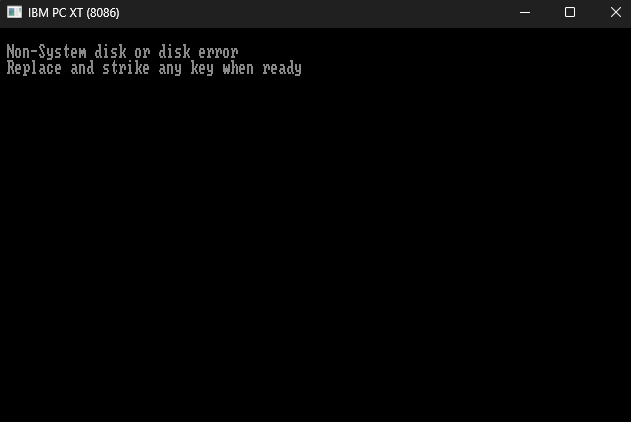
Obviously, it’s also necessary to display progress of the boot, so I had to implement CGA in text mode, which turns out to be pretty easy (each character is represented by two bytes: character byte and attributes, which define its color. You can completely ignore this byte in the early stage just so you can show something on the screen).
Pic 1

Humble beginnings

In this early step, you can also completely skip BIOS considerations and just provide a high level emulation (HLE, in Rust) of the requested services. For example, when the boot code calls an interrupt to display a character, simply intercept that call and display it at the right coordinates on the screen.

It’s surprisingly easy to reach a basic MS-DOS prompt this way, so the next step was to remove the HLE, install a BIOS and implement the correct backend mechanisms.

BIOS
Pic 1

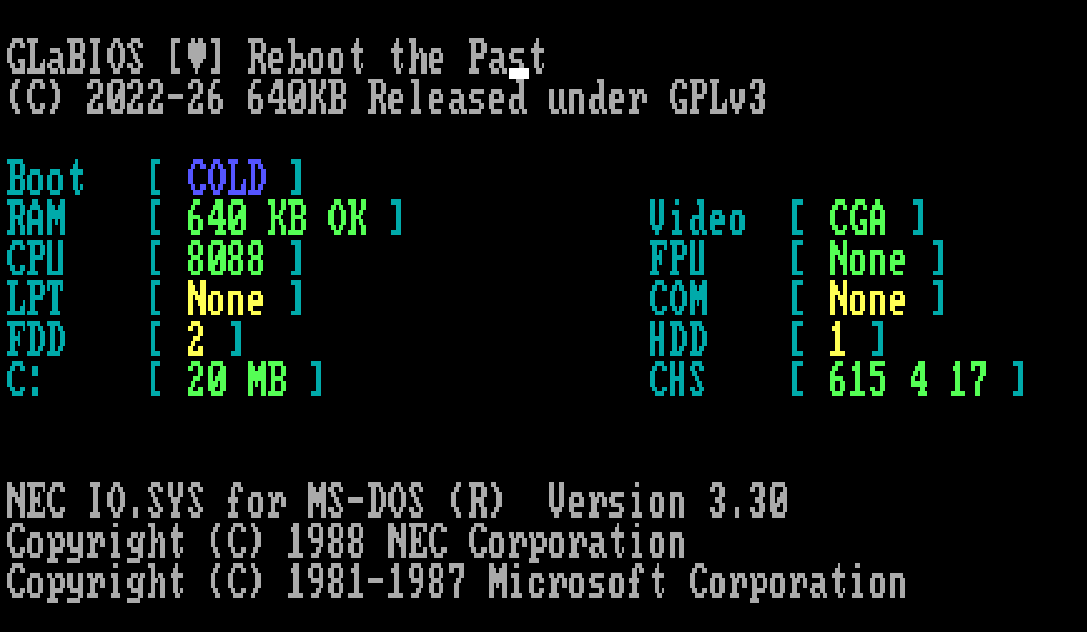
GlaBIOS coming to life

I picked GlaBIOS, a free BIOS.

The first hurdle is the Power On Self Test (POST). When run at boot, the BIOS does a quick check of all the various components (memory, keyboard, floppy, timer, …) and issues an error if it detects any problem. Since I had nothing implemented at this stage, the BIOS errored out pretty early, but it was pretty easy to return stubbed answers in lieu of the actual responses in order for the BIOS to proceed until it gives control to the content of the floppy disk.

The main difference with the HLE approach is that instead of intercepting the interrupt and implementing it manually (e.g. display character ‘A’ at coordinates 10,10), the BIOS will instead output these values directly in graphic memory, so you need to implement true CGA support for that next phase.

Floppy disk

Disk images are captured in .img​ files which are a simple dump of all the bytes on the disk, sector after sector. The geometry of the file depends on the type of image you are emulating (e.g. floppy disk vs/ hard drive). In this early phase, I only needed to implement support for floppy disks, and the PC XT uses DMA in order to transfer bytes between the floppy disk and system memory, so I had to implement both the floppy disk operations and also DMA access. The clean separation between these two systems is quite elegant, as opposed to the Apple 2, which doesn’t have such clean boundaries.

Graphics

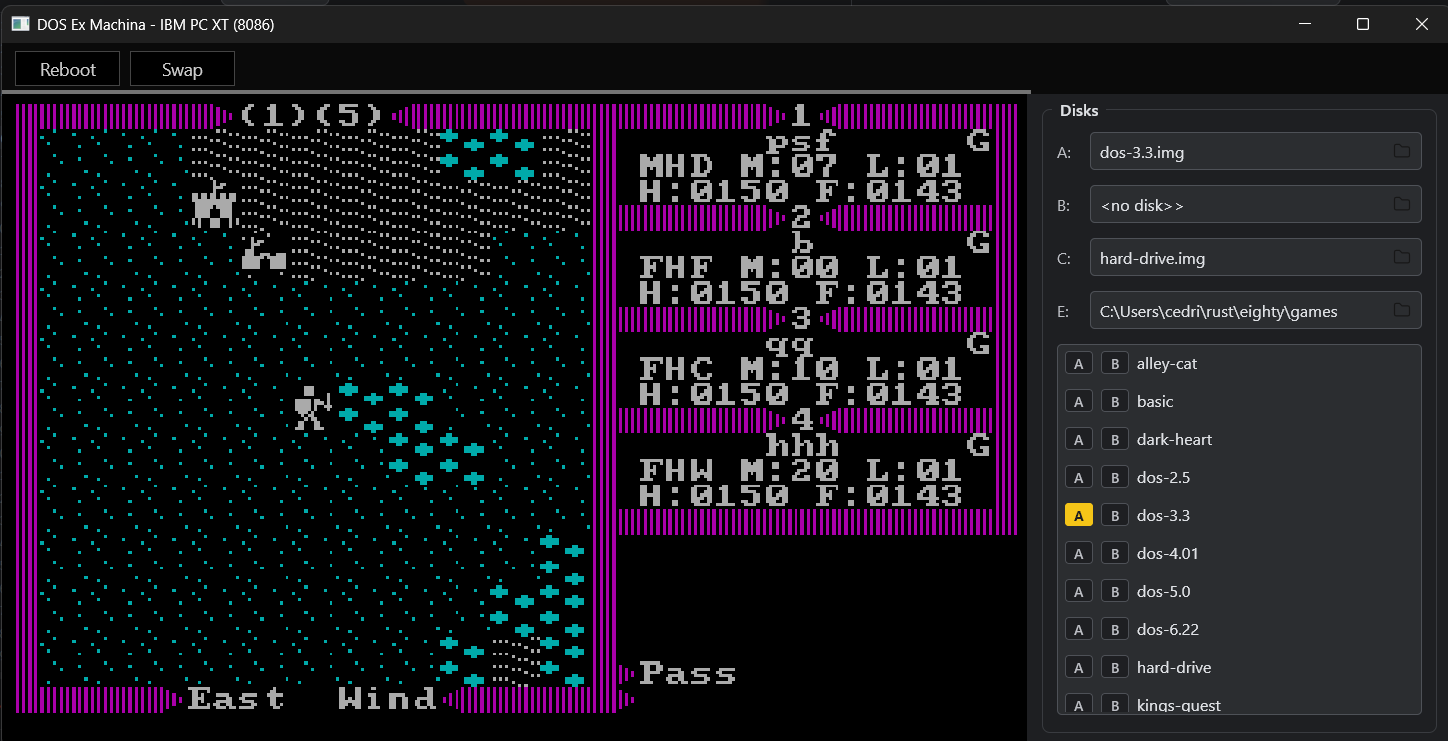
The next step was graphics. CGA is a pretty simple format with the only quirk that even and odd lines are not contiguous (not unlike the Apple 2, which has an even stranger frame buffer layout).

In lower resolution (320x200), CGA only has four colors so each pixel is represented by two bits which index into the selected color palette. Higher resolution (640x200) only has two colors, so each pixel is represented by one bit.
Pic 1

Ultima 3 is always beautiful, even in CGA

Quality of life

At this point, I have several games and disk images successfully booting and running but juggling them started to be time consuming, especially since some of them boot directly while others need a DOS disk to boot first, and then transfer control to. So I decided to add a feature to my emulator that would make my life easier.

The idea is simply to check out which disks are inserted in A and B and depending on that information, inject key strokes in order to automatically boot to where I want the game/app to be. For example, DOS typically asks you for date and time when it boots (skip that by injecting two return keys), then switch to drive B:, then cd to a directory, and then run the executable.

/// Inject keys at boot time depending on which disks are inserted
pub const SCRIPTS: &[(&str, &str)] = &[
    ("prince", "\r\rb:\rprince.exe\r"),
    ("duck", "\r\rb:\rb:duck.exe\ry"),
    ("dos", "\r\re:\r"),
];

This made testing my emulator (both manually and automatically) much easier and it was also a good opportunity for me to get a deeper understanding of how to hook into the BIOS/DOS process in order to inject keys in the best way possible. I started gaining a strong appreciation on how all these pieces interact with each other, but more on this later.

Hard drive

Now that I had multiple floppy disks booting and running correctly, it was time to look at the next step: hard drive support. While hard drive images are stored in exactly the same way as floppy disks, the PC XT handles them differently from floppy disks, but in the end, the same code providing resolution of cylinder/head/sector to physical addressing can be reused.

Hard drive support was easy to implement but at that point, I faced my next challenge.

There is a lot of abandonware games/apps that are available to test a PC XT emulator, but most of them are provided in “exploded” form: a zip file containing all the files in a directory (.COM, .EXE, assets, etc…). At this time, my emulator only knows how to manage .img files, not exploded directories.

A simple solution is to build an app that will transfer files from my local hard drive to an .img file, and that’s a utility that I actually already have. Still, the process is tedious and I thought I would really prefer to download the app on my hard drive and have my emulator magically see it and be able to change directory to it and run apps directly from there.

Virtual file system

Since this is such a convenient feature, DOSBox supports it with the imgmount​ command but I decided that I wanted to write as little assembly and as much Rust as possible, so I looked into providing this support with HLE again.

After a great deal of research and a lot of reading, I learned more about how flexible MS-DOS was and how it makes it easy to plug into various areas of disk management. In particular, the feature I was looking for is called “Network redirector”, and this is how MS-DOS provided support for CD ROMs and other mass storage.

In a nutshell, there are two ways to expose a local hard drive to MS-DOS. You can go low level, which leverages the BIOS but requires you to emulate a lot of low level access (basically filling strategic memory areas that DOS manages), or you can skip the BIOS and just implement higher level primitives to essentially expose a virtual file system. These higher level commands are the likes of Open File, Load File (in memory), Find First / Find Next (to enumerate files, e.g. for the “dir” command”), etc…

I decided to go for this approach since it requires a lot less extremely details DOS emulation, but before I got there, I had one more thing to do: wait for MS-DOS to boot and then run a few instructions of assembly to query some important information from the operating system, so that I can hook my network redirector.

This is something I have never needed to do in my previous emulators, but it ended up being pretty easy. First, MS-DOS has several points in its boot process that you can reliably wait for, and when you reach such a point, you just need to 1) save all registers/flags 2) run the assembly you need 3) save the results in your internal structure 4) restore registers/flags and finally 5) resume CPU ticking.

    /// Return (major, minor)
    fn get_dos_version(&mut self) -> (u8, u8) {
        // B4 30    MOV AH, 30h
        // CD 21    INT 21h
        // F4       HLT
        let code = [0xb4, 0x30, 0xcd, 0x21, 0xf4];
        let (al, ah) = self.run_assembly(&code, AL, AH);
        (al as u8, ah as u8)
    }

Once these “shims” were in place and running, I was able to see the interrupt 2Fh correctly routed to my virtual file system, and after that, it was just a matter of implementing each command, one by one. While some details of the implementation can be a bit gnarly, the process is pretty much the same for all commands: read the parameters (passed in registers and in specific DOS memory), execute the operation requested on your local hard drive (open file, transfer bytes from the file into memory, etc…), update the parameters and DOS memory, and return.
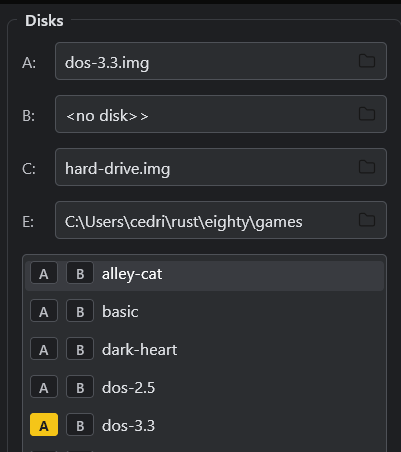
Pic 1

How the disks are mapped

Pic 1

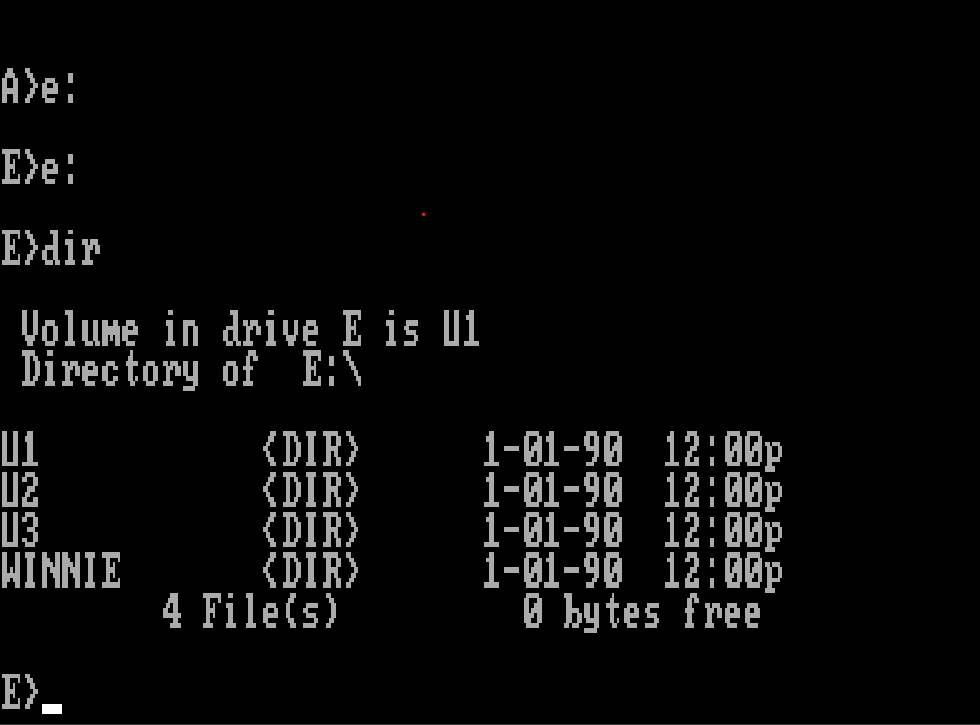
Next thing I know, the drive E: in my emulator is mapped to my local hard drive and I am now able to download and run pretty much anything I put my hands on, which makes testing the emulator much easier.
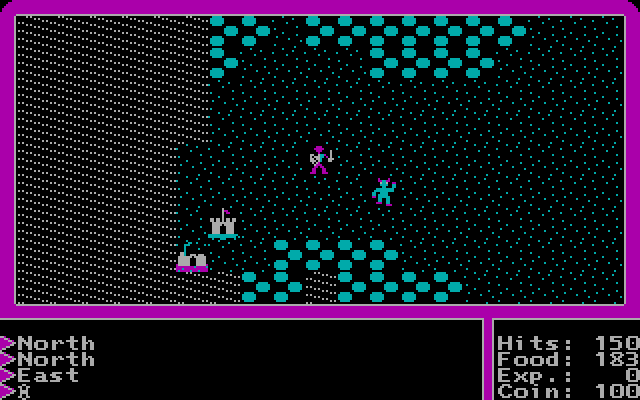
Pic 1

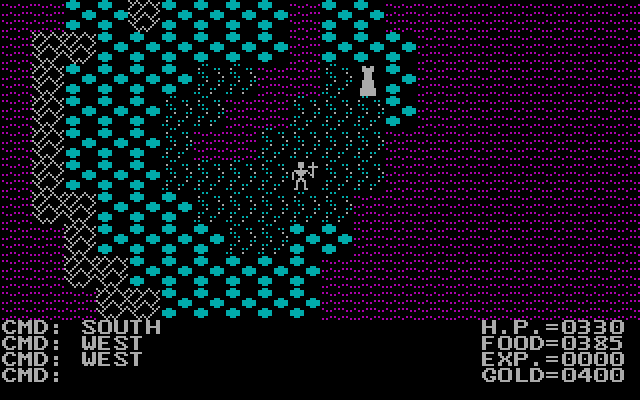
Ultima 1

Pic 1

Ultima 2

Pic 1

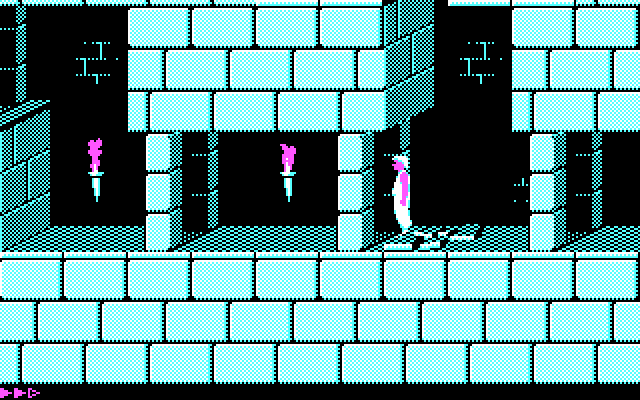
Prince of Persia

Next steps

Now that I have verified that my emulator correctly runs a lot of CGA games (I usually test the Ultima series first, for nostalgia reasons), it is now time to turn my attention to EGA.

My early readings on this format make me pretty excited: there’s going to be a lot of bit shifting, latches, rotation, modes, etc… All of the fun stuff that I have great joy implementing in emulators. I can’t wait to see these improved graphics displayed in my emulator.
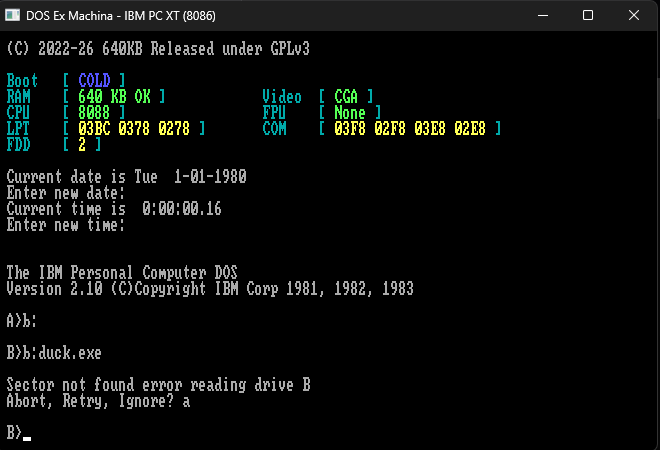
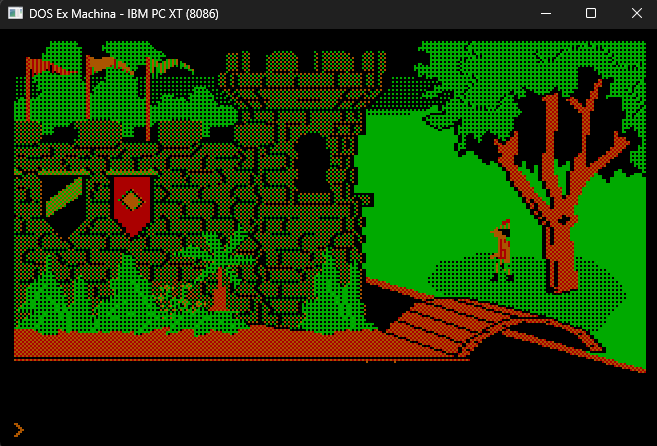
A few weeks ago, I embarked on my latest project: writing a PC-XT emulator (8086). I had wanted to do this for a very long time because I felt that my knowledge of Intel CPUs was lacking, so I decided to dive in. It’s been a fun journey so far, starting by getting my CPU to pass all the tests, and then tackling the emulator itself. I’m including a few screenshots of the progress so far, from just showing the very beginning of the boot process, emulating the BIOS, then using a real BIOS, then implementing disk drives, then CGA. A lot more to work on, but it’s been very exciting so far, and as much I dislike the 8086 assembly, there are a lot of very interesting things in this architecture designed more than forty years ago, and which powers our civilization today...

I have a very complex relationship with math. I minored in math but I was really bad at it, and my classmates were regularly running rings around me. My mind was simply not a good fit for it. Then I switched to a computer science major, and everything changed.

But even back then, I realized that math was special. It’s so much more painfully obvious to me now, but it took a while to get there.

You might know the joke about this math student asking their math teacher “Will I ever use this in my life, ever??”.

And the math teacher responding “Your smart and successful classmates will”.

Such a slap in the face.

But there is a lot of truth to that joke. Math teaches you a lot of things that are not directly applicable to the real world, but that is its purpose, and what makes it so important. Sure, you take a math class, don’t understand a word of it, and drop out. Understandable. But how many other people do the same thing as you? 99% of the class? What do you think about this? Don’t you want to be one of these special cases, one that doesn’t give up easily, one that keeps trying when everyone else gave up?

Math is like jogging. There is no sport that requires you to jog at a medium pace for a half hour. But then, why do the best athletes in the world go jogging several times a week?

Because it trains your body and prepares it for bigger challenges. And that’s exactly what math does. It shapes your brain, extends it, challenges it, and prepares it to view the world in abstract ways that very, very, VERY, few people see.

My kids regulary ask me this very same question, whether I use math in my daily life. And my response is unwaveringly “All the time”. I use math when I drive, in traffic, when I read email, when I watch or practice sport, when I look at the layout of my house or whenever I write code. It’s a constant presence.

Math helps me solidify those natural pattern seeking recognition skills that evolutional biology has wired in my brain for tens of thousands of years. I notice things, put them together, draw conclusions, derive decisions.

It’s very hard to explain and put into words, but math is probably the most important thing I ever studied in my entire life, and I can’t wait to learn more of it.

It’s fascinating to me that so many years after the concept of Dependency Injection (DI) became popular, so many people still don’t seem to understand what it is and why it’s such a fundamental idea that transcends languages.

“I already have Dependency Injection, it’s called ‘passing parameters’”

- Pretty much everyone in a discussion about Dependency Injection

No, passing dependencies as parameters is not DI and it’s actually a terrible way of building software. Let’s explore why.

Dependency Injection, the wrong way

Let’s imagine a typical application that starts at main() and then ends up calling a function you are working on, let’s call it “sendPacket()”:

fun main() {
  f()
}

fun f() {
  g()
}

fun g() {
  sendPacket(packet)
}

fun sendPacket(packet: Packet) { ... }

Next, you decide you want to log whenever a packet is sent, so you need a logger. The traditional, non DI (and wrong) way to do this would be to instantiate this logger as high as possible (so it can be used by other functions) and then passed down:

fun main() {
  val logger = Logger()
  f(logger)
}

fun f(logger: Logger) {
  g(logger)
}

fun g(logger: Logger) {
  sendPacket(packet, logger)
}

fun sendPacket(packet: Packet, logger: Logger) { ... }

Here are some things that are immediately apparent in this new version of the code:

  • By adding this dependency to sendPacket(), I have impacted all the callers, who now have to pass a logger even though they never need one themselves.
  • Anyone who wants to call sendPacket() now needs to find such a logger, even though all they want to do is send a packet.
  • sendPacket() is now exposing private details to the outside world, its encapsulation is now completely broken.
  • This approach will never scale. Imagine a code base of millions of lines of code and the effect that adding a logger to one function will cause on the entire code base.

A few quick observations before we dive deeper:

  • It is not the purpose of this article to analyze why being able to create these instances differently based on the deployment environment (e.g. production, testing, staging, benchmarking, etc…) is desirable.
  • This problem statement generalizes to classes as well, except that you would pass these dependencies in the constructor with the same devastating effect.
  • The monadic approach to this problem (usingReader) suffers from this exact problem (on top of introducing monads, which create even more issues).

A better approach

Having established that passing dependencies as parameters is not a good idea, what are our options?

Here are a couple:

  • Make the dependencies global variables.
    We all know how bad an idea that is, but while it turns the code into an ungodly pile of spaghetti, it does address the encapsulation breaking aspect: functions can add dependencies to their implementations without impacting callers since these dependencies are no longer passed as parameters.
  • Find a way to “inject” the dependency where it’s needed, and only where it’s needed.
    This way, the dependency can’t be seen nor used by anyone that doesn’t need it and callers are none the wiser.

And this is where the word “Injection” comes into play.

Java and Kotlin have a great mechanism for DI (they are not the only ones, but I’ll focus on them since their approach is fairly well known by now).

It’s very simple: you use the annotation @Inject to mark values as dependencies, and this annotation can be used in different places based on your scenario. The limitation of this annotation in Java and Kotlin is that it cannot be directly injected into a function (and just that function), so instead, we declare it in the class that this function belongs to, but the effect is the same:

class PacketSender {
    @Inject
    val logger: Logger

```kotlin
fun sendPacket(packet: Packet) {
    logger.log("Hello")
    // send packet
}

}


The encapsulation aspect is neatly fixed by this approach: the developer of the `PacketSender` class can add and remove dependencies with abandon without ever impacting the signature of `sendPacket()`, which means that its users will never break.

The next issue to address is how to instantiate a class like `PacketSender` with the right dependencies, but I will leave that aside since this is a problem that's pretty well documented and solved by the various DI libraries that are available today. Instead, I'd like to follow these observations with a short discussion about how we could improve on this mechanism even further.

## A language with native support for DI

As I mentioned above, the one limitation of the Java/Kotlin approach to DI is that the injection is still too broad: it needs to be done at the class level, which means these dependencies are visible to all the functions of the class. Can we do better?

Well, not with the current versions of Java and Kotlin, but let's think about what this could look like.

We have established that functions need two kinds of parameters:

  * "Business parameters", values that the function needs to perform its function.
  * "Dependency parameters" (or we could call them "Support" or "Utility" parameters), values that the function can use for reasons that are not directly related to its function and which should be kept as private implementation details. 


The interesting observation here is that these two kinds of parameters are coming from different origins, and the signature of the function should reflect that. Which led me to the following (hypothetical) syntax:
```kotlin
fun sendPacket(packet: Packet)(logger: Logger) {
    logger.log("Hi")
    // send packet
}

We now have two lists of parameters, with the second one being optional. Any parameter mentioned in that second list of parameters will have to be supplied by the DI runtime of the language and its parameters are only visible while inside the function. Callers of such functions only have to supply the parameters in the first list and can completely ignore the dependency parameter list.

With this approach, we achieve the desired encapsulation and we cleanly separate the parameters in two very distinct categories, which improves the readability of the code without compromising type safety. Dependencies are created “somewhere else” (to be defined, but like I said above, existing DI frameworks have given us plenty of interesting mechanisms to build these dependencies) and passed transparently to functions without ever impacting callers.

Guice’s “Assisted Injection” offers a mechanism that’s very similar to what I’m proposing (here is an article with more details about it), but other than that, I haven’t found any language trying to solve this particular problem. Please let me know if you know of any!

This is a follow up to my previous article, in which I explored a few aspects of Kotlin that Rust could learn from. This time, I am going to look at some features that I really enjoy in Rust and which I wish that Kotlin adopted.

Before we begin, I’d like to reiterate that my point is not to start a language war between the two languages, nor am I trying to turn one language into the other. I spent careful time analyzing which features I want to discuss and automatically excluded features that make perfect sense for one language and would be absurd in the other. For example, it would be silly to ask for garbage collection in Rust (since its main proposition is a very tight control on memory allocation) and reciprocally, it would make no sense for Kotlin to adopt a borrow checker, since the fact that Kotlin is garbage collected is one of its main appeals.

The features I covered in my first article and in this one are functionalities which I think could be adopted by either language without jeopardizing their main design philosophies, although since I don’t know the internals of either languages, I might be off on some of these, and I welcome feedback and corrections.

Let’s dig in.

Macros

I have always had a love hate relationship with macros in languages, especially non hygienic ones. At the very least, macros should be fully integrated in the language, which requires two conditions:

  • The compiler needs to be aware of macros (unlike for example, the preprocessor in C and C++).
  • Macros need to have full access to a statically typed AST and be able to safely modify this AST.

Rust macros meet these two requirements and as a result, unlock a set of very interesting capabilities, which I’m pretty sure we’ve only started exploring.

For example, the dbg!() macro:

let a = 2;
let b = 3;
dbg!(a + b);

Will print

[src\main.rs:158] a + b = 5

Note: not just the source file and line number but the full expression that’s being displayed (“a + b”).

Another great example of the power of macros can be seen in the [debug_plotter](https://crates.io/crates/debug_plotter) crate, which allows you to plot variables:

fn main() {
    for a in 0..10 {
        let b = (a as f32 / 2.0).sin() * 10.0;
        let c = 5 - (a as i32);

        debug_plotter::plot!(a, b, c; caption = "My Plot");
    }
}

How beautiful and geeky is that?

Kotlin is not completely unarmed in this department since the mix of annotations and annotation processors provide a set of functionality that is not very far from what you can do in Rust with macros and attributes. The main difference is that while Kotlin’s approach only allows for legal Kotlin code to ever be present in a Kotlin source file, Rust allows for any arbitrary syntax to appear as a macro argument, and it’s up to the macro to generate correct Rust that the compiler will accept.

I have to admit that my mind is not fully made on this particular aspect.

On one hand, it’s nice to be able to write any kind of code in a Rust source file (this is what React does with JSX), on the other hand, the potential for abuse is high and one can rightfully fear a day when a Rust source file would look nothing like Rust code. However, so far, my fear has never materialized and most macros that I have encountered use custom syntaxes very parsimoniously.

Another very important aspect of macros is that Rust IDE’s understand them (well, at least, CLion does, and potentially, all IDE’s can, and will) and they will immediately show you errors when something is going wrong.

Macros are used in a very large array of scenarios and provide Rust with some really neat DSL capabilities (e.g. for libraries supporting SQL, Web, graphics, etc…).

Also, macros integrate very neatly with…

Attributes for preprocessing

Attributes are Rust’s version of annotations and they start either with # or #!:

#![crate_type = "lib"]

#[test]
fn test_foo() {}

Nothing groundbreaking here, but what I want to discuss is the conditional compilation aspect.

Conditional compilation is achieved in Rust by combining attributes and macros with cfg, which is available as both an attribute and a macro.

The macro version allows you to compile conditionally a statement or an expression:

#[cfg(target_os = "macos")]
fn macos_only() {}

In the code above, the function macos_only() will only be compiled if the operating system is macOS.

The macro version of cfg() allows you to add more logic to the condition:

let machine_kind = if cfg!(unix) {
    "unix"
} else { ... }

At the risk of repeating myself: the above code is a macro, which means it’s evaluated at compile time. Any part of the condition that is not meant will be completely ignored by the compiler.

You might rightfully wonder if such a feature is necessary in Kotlin, and I asked myself the same question.

Rust compiles to native executables, on multiple operating systems, which makes this kind of conditional compilation pretty much a requirement if you want to publish artifacts on multiple targets. Kotlin doesn’t have this problem since it produces OS neutral executables that are run on the JVM.

Even though Java and Kotlin developers have learned to do without a preprocessor since the C preprocessor left such a bad impression on pretty much everyone who has used it, there have been situations in my career where being able to have conditional compilation that includes or excludes source files, or even just statements, expressions, or functions, would have come in handy.

Regardless of where you stand in this debate, I have to say I really enjoy how two very different features in the Rust ecosystem, macros and attributes, are able to work together to produce such a useful and versatile feature.

Extension traits

Extension traits allow you to make a structure conform to a trait “after the fact”, even if you don’t own either of these. This last point bears repeating: it doesn’t matter if the structure or the trait belong to libraries that you didn’t write. You will still be able to make that structure conform to that trait.

For example, if we want to implement a last_digit() function on the type u8:

trait LastDigit {
    fn last_digit(&self) -> u8;
}

impl LastDigit for u8 {
    fn last_digit(&self) -> u8 {
        self % 10
    }
}

fn main() {
    println!("Last digit for 123: {}", 123.last_digit());
    // prints "3"
}

I might be biased about this feature because unless I am mistaken, I was the first person to suggest a similar functionality for Kotlin back in 2016 (link to the discussion).

First of all, I find the Rust syntax elegant and minimalistic (even better than Haskell’s and arguably, better than the one I proposed for Kotlin). Second, being able to extend traits this way unlocks a lot of extensibility and power in how you can model problems, but I’m not going to dive too deep into this topic since it would take too long (look up “type classes” to get a sense of what you can achieve).

This approach also allows Rust to mimic Kotlin’s extension functions while providing a more general mechanism to extend not just functions but types as well, at the expense of a slightly more verbose syntax.

In a nutshell, you have the following matrix:

| Kotlin| Rust
—|—|—
Extension function| fun Type.function() {...}| Extension trait
Extension trait| N/A| Extension trait

cargo

This probably comes off as a surprise since with Gradle, Kotlin has a very strong build and package manager. The two tools certainly have the same functional surface area, allowing to build complex projects while also managing library downloading and dependency resolution.

The reason why I think cargo is a superior alternative to Gradle is because of its clean separation between the declarative syntax and its imperative side. In a nutshell, standard, common build directives are specified in the declarative cargo.toml file while ad hoc, more programmatic build steps are written directly in Rust in a file called build.rs, using Rust code calling into a fairly lightweight build API.

In contrast, Gradle is a mess. First because it started being specified in Groovy and it now supports Kotlin as the build language (and this transition is still ongoing, years after it started), but also because the documentation of both of those is still incredibly bad

By “bad”, I don’t mean “lacking”: there is a lot of documentation, it’s just… bad, overwhelming, most of it outdated, or deprecated, etc…, requiring hundreds of lines of copy/paste from StackOverflow as soon as you need something out of the beaten path. The plug-in system is very loosely defined and basically lets all plug-ins access whatever they feel like inside Gradle’s internal structures.

Obviously, I am pretty opinionated on this topic since I created a build tool inspired by Gradle but using more modern approaches to syntax and plug-in resolution (it’s called Kobalt), but independently of this, I think cargo manages to strike a very fine balance between a flexible build+dependency manager tool that covers all the default configuration adequately without being overwhelmingly complex as soon as your project grows.

u8, u16, …

In Rust, number types are pretty straightforward: u8 is an 8 bit unsigned integer, i16 is a 16 bit signed integer, f32 is a 32 bit float, etc…

This is such a breath of fresh air to me. Until I started using these types, I had never completely identified how uncomfortable I had always been with the way C, C++, Java, etc… define these types. Whenever I needed a number, I would use int or Long as default. In C, I sometimes went as far as long long without really understanding the implications.

Rust forces me to pay very close attention to all these types and then, the compiler will relentlessly keep me honest whenever I try to perform casts that can lead to bugs. I really think that all modern languages should follow this convention.

Compiler error messages

Not to say that Kotlin’s error messages are bad, but Rust certainly set a new standard here, in multiple dimensions.

In a nutshell, here is what you can expect from the Rust compiler:

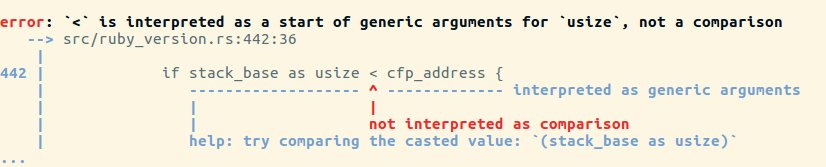
  • ASCII graphics with arrows, colors, clear delineations of problematic sections.
  • Plain English and detailed error messages.
  • Suggestions on how you could fix the problem.
  • Links to relevant documentation where you can find out more about the problem.

I certainly hope that future languages will take inspiration.

Portability

About twenty-five years ago, when Java came out, the JVM made a promise: “Write once, run anywhere” (“WORA”).

While this promise stood on shaky grounds in the early years, there is no denying that WORA is a reality today, and has been for a couple of decades. Not only can JVM code be written once and run everywhere, such code can also be written anywhere, which represents an important productivity boost for developers. You can write your code on any of Windows, macOS, Linux, and deploy on any of Windows, macOS, and Linux.

Surprisingly, Rust is also capable of such versatility, even though it produces native executables. Regardless of the operating system you are writing your code on, producing executables for a multitude is trivial, with the added benefit that these executables are native and, thanks to the incredible technical achievement that the LLVM is, very performant too.

Before Rust, I had resigned myself to the fact that if I wanted to run on multiple operating systems, I had to pay the price of running on a virtual machine, but Rust is now showing that you can have your cake and eat it too.

Kotlin (and the JVM in general) is beginning to learn this lesson too, with initiatives such as GraalVM, but producing executables for JVM code is still fraught with restrictions and limitations.

Wrapping up

I have a lot more to say about all of this.

And by “all of this”, I mean “Rust and Kotlin”.

They are both such interesting languages. I like them both, but for different reasons. I hope I was able to convey some of my fondness in these two posts. Even though these articles might appear critical, they are really love letters. I am a very demanding developer, someone who’s been writing code for forty years and who plans to keep doing so for as long as his mental abilities allow him. I feel unreasonably passionate about programming languages, and I hope that my passion shone through these two articles.

TestNG is a project I started around 2004 with the only intent to mix things up. I wanted to show the Java world that we could do better than JUnit. I had no intentions for anyone to like and adopt TestNG: it was a project lab. An experiment. All I wanted to do was to show that we could do better. I was genuinely hoping that the JUnit team (or whatever was left of it) would take a look at TestNG and think “Wow, never thought of that! We can incorporate these ideas in JUnit and make it even better!”.

This is my goal with these couple of posts. I would be ecstatic if these two very, very different worlds (the Rust and Kotlin communities) would pause for a second from their breakneck development pace, take a quick look at each other, even though they really had no interest in doing so, and realize “well… that’s interesting… I wonder if we could do this?”.

Discussions on reddit:

Stay updated with Otaku

Subscribe or follow along for articles on development, software engineering, and reflections.