HHH = A
HHT = B
HTH = B
HTT = C
THH = B
THT = B
TTH = B
TTT = D
25%
"It's all in the wrist."
Danil
'cept that I threw in some Bs that should be Cs :(
Cedric
Wrong :-)
Cedric
Still wrong :-)
tjsnell
You should switch doors.
HimJim
0
Cerdeira
The right answer is 50%
Because the probability is 25% but because you have 2 25% in 4 possible :D 2/4 = half so 50% :D
My brain is hurting me ;)
Cheers,
Jo??o Cerdeira
Daniel Spiewak
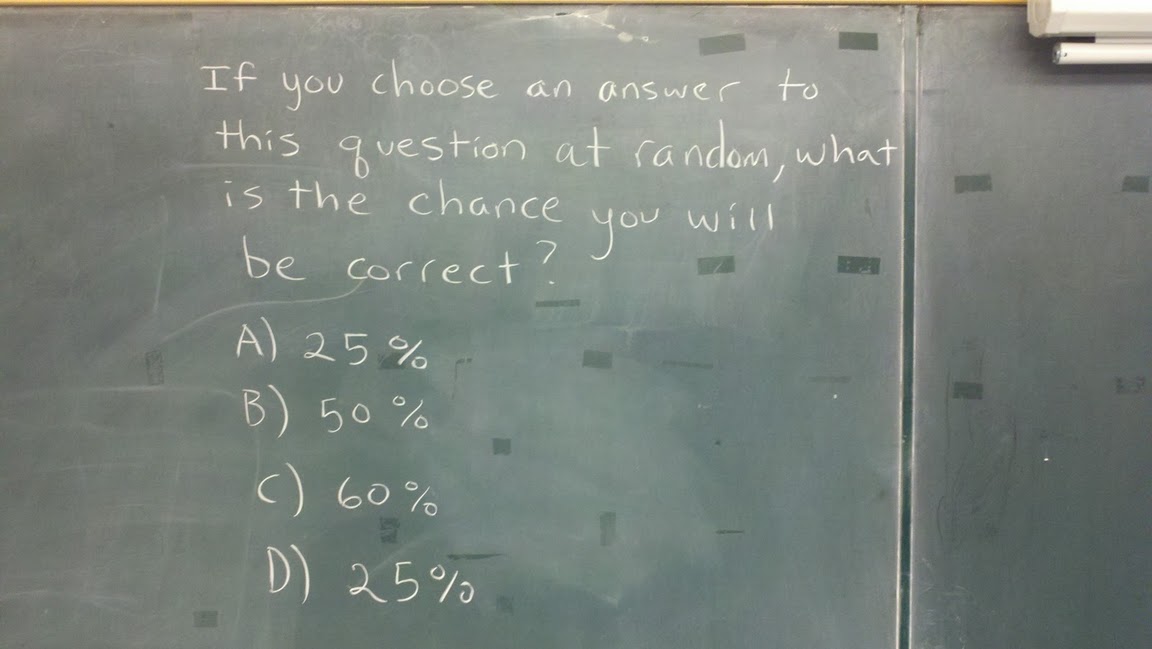
Here's the trick: the answer 25% appears twice, thus it cannot be correct since, if it were, the correct answer would be 50% instead of 25%. Unfortunately, 50% is also incorrect, since it only appears once, and this the probability of selecting *that* answer at random is 25%, not 50%. By a similar argument, we can eliminate 60%. Thus, there is no correct answer to this question.
In other news: this is awesome.
Cedric
Daniel: it is awesome indeed. And your answer is incorrect :-)
Uncle Bob
A question that appeared on a chemistry exam:
Write a question suitable for a chemistry exam and then answer it.
Pedro Furlanetto
I got the same conclusion you did but at the G+
Pedro Furlanetto
I meant "Daniel, I got the same conclusion you did but at the G+"
Michael Chermside
Like Daniel said, except that the answer is 0 percent. The question never stated that the answer must be A, B, C, or D. And I am assuming that "chose an answer at random" means to choose from amongst A, B C, and D with uniform likelihood.
Runar
The question has a type error, and the answer is bottom. It's an infinite regression that alternates between 25% and 50% but never converges.
I'm sorry, but paradoxes are not profound. Bottoms lead to nontermination, not enlightenment.
Cedric
Runar: wow, you must be fun at parties :-)
Anyway, your answer is wrong. There is a correct answer and it's one of the four listed. No tricks.
Having said this, you are touching on something interesting with your "type error" observation, which I'll cover in my answer.
Daniel Spiewak
So, there's something a little interesting about the fact that we're choosing an answer uniformly at random. Thus, we have a 50% chance of selecting 25%, and a 25% chance of selecting 50%. This, I believe, is the key to the answer...
0.25 * 0.5 = 0.125
0.5 * 0.25 = 0.125
0.125 + 0.125 = 0.25
Thus, the correct answer is 25%, which is to say, both A and D.
rdm
If "choose an answer to this question at random" means pick one option from {A,B,C,D{ then 50% of the answers will be 25%, 25% of the answers will be 50%, and 25% of the answers will be 60%. If it means pick a distinct value from the set 25%, 50%, 60% then the answers would be 1/3 of each. Since a 1/3 probability has nothing to do with the available answers let's ignore that.
That leaves the question of "correctness". And a question here is whether there is a single correct value or whether there is a series of correct values. But let's assume that there is a single correct value. But, that single correct value depends on what "correctness" means. One possibility is that correctness corresponds to the numerical values listed. But this concept leads to contradictions. Another possibility is that there is one correct answer and that that answer is either A, B, C or D and that we do not know what that answer is.
If this latter definition of correctness is being used (and it's sadly representative of educational testing), then the answer is obvious.
Rik
It depends on the answer. If answer is 25%, it is 50%. Otherwise 25%.
Micharl
The answer is B
Patrick Gras
There is 0% chance I will be correct,
because if I may choose:
25% with 50% of chances
50% with 25% of chances
60% with 25% of chances
but I have no chance to choose:
X% with X% chances...
Dominique Gallot
If you carefully read the question, you will understand that there are no correct answers
??If YOU??, so the number of answer is 1, your result can be only wrong or correct. Therefore the only valid responses are 0% or 100%, which anyway are not in the list.
Maarten
e. 20%
Rapha??l Jolly
The question doesn't imply that the answer is in the list. So, 0%
fischi
Dominique, i think you are on the right track.
Noone said you had to choose an answer from the given (4) choices - so there a two theories:
* it is an open question, so the possibility of random answers is infinite, therefore the propability of getting it right is nearly 0%. as 0% is not listed, i assume the question to be yes or no.
* in this case, randomly chosen, you get the 50% propability.
The answer (if you follow this type of thinking) would be B, 50%.
Cedric will tell us, if i got it right. If it is purely mathematical AND you have to choose from the FOUR answers given, i will have to reconsider ;)
Denis
50% because probability of 25% is 2/4 = 0.5 = 50%. There is no such thing as "depends" because only 25% is the correct answer.
Dennis Lenaerts
By "choosing an answer at random", you do mean de set of possible answers is {A,B,C,D}, and the probabilities are uniformly distributed across all four answers, right?
If not, you could just choose within {A,B} with 1/2 probability for each answer, and B would be correct.
Kevin Wright
I say it's a bit of a trick question. It doesn't state that your answer absolutely must be one of those listed.
There's a 25% chance that you'll pick 50%
A 25% chance that you'll pick 60%
and a 50% chance that you'll pick 25%
Therefore, the chance that you'll be correct by randomly choosing one of the listed answers is 0%
Michael
If you choose your answer by logic and reason, then your pick is not random any more.
The criterion to decide, if an answer is correct, is to assert, that you have picked truly randomly. So, when you try to pick randomly and i make assertions on each pick (guessing), how often would i assert right?
I would flip a coin.
Manu
the probability that it's not 25% are 50%, for 50% it's 25% and for 60% it's also 25% hence:
0.25 *0 .5 = .125
0.5*0.25= 0.125
0.6*0.25=0.15
this adds up to a probability of 40% that it's none of the answers so the probability should be 1-0.4 which leaves us with 60%
fla
One random answer ? It could be anything. So my guess is that i have 1/infinity to find the correct answer :)
adam
the answer is 1
John O'Brien
Suppose we take a different problem as our starting point.
Assuming that we have two options, option A and option B, and the correct answer is 10% of the time is option A, and 90% of the time is Option B. If we chooose either option randomly, and we have
an equal chance of choosing either option, what are the chances we choose the correct option?
In order to answer this problem, we need to figure out what the chances are that the correct answer will be option A, and we will choose option A, or that the correct answer will be option B, and
we will choose option B.
So..
Option Chance it is Correct Chance we Chose this Option Percentage of the Time we Chose Correctly
A 10% 50% 5%
B 90% 50% 45%
So, for option A, it is the correct answer and we choose it as the correct answer 10% * 50% of the time = 5% of the time.
For option B, we choose it and it is the correct answer 90% * 50% = 45% of the time.
Adding them together, 5% + 45% of the time = 50% of the time we choose the correct answer, if we choose randomly.
Now let's notice something interesting about this problem. Since the chance that Option A is correct or Option B being correct in sum is 100% (10% + 90% = 100%), we don't actually need to know that
chance that option A is correct or the chance that option B is correct. Indeed, since they sum to 100%, and the chance that we choose either one is 50%/50%, any combination of the chance that A is
correct or that B is correct will yield the same percentage of the time we choose the correct answer (that is, 50%).
This will be true so long as the chance that we choose either option is evenly split, and the chance that all options are correct sums to 100%.
Now, if we add four options, and do the same calculation, we get that there is a 25% chance that we choose the right answer.
Option Chance is it Correct Chance we Chose this Option Percentage of the Time we Chose Correctly
A 25% 25% 6.25%
B 25% 25% 6.25%
C 25% 25% 6.25%
D 25% 25% 6.25%
6.25% + 6.25% + 6.25% + 6.25% = 25%
But, hang on, you say, if that is the case, then the correct answer is both A and B.
Okay, I say. So, let's articulate that as another table, where choosing option A is correct 100% of the time, and choosing option D is correct 100% of the time. Now we end up in a very different circumstance than in the first case, when we just had options A and B. Since the two options are correct, the sum chance that of any option being correct is 200%, not 100%.
Chance it is Correct Chance we Chose this Option Percentage of the Time we Chose Correctly
A 100% 25% 25%
B 0% 25% 0%
C 0% 25% 0%
D 100% 25% 25%
50.00%
Which would make the *real* correct answer 50%. Does that mean that the real correct answer is to say that 50% was correct 100% of the time?
Let's articulate that as another table, where choosing option D is correct 100% of the time.
Chance it is this option Chance we Chose this Option Percentage of the Time we Chose Correctly
A 0% 25% 0%
B 100% 25% 25%
C 0% 25% 0%
D 0% 25% 0%
25%
So it appears we have a paradox. If the correct answer is 25%, then we will choose that answer 50% of the time. If the answer is 50%, then we will choose that answer 25% of the time.
Of course, part of the problem is the phrasing "if you choose to answer this question at random," which is imprecise. I have taken it to mean if you chooose one of the four options randomly, with
an equaly chance of choosing any of the four options.
If instead (as other commenters have noted) you take the whole answer set as the options to choose among (so the correct answers to choose are either 25%, 50%, or 60%), then the problem does have a
solution, but it is not one of the solutions listed.
Chance it is this option Chance we Chose this Option Percentage of the Time we Chose Correctly
A 33% 33% one ninth
B 33% 33% one ninth
C 33% 33% one ninth
33%
What if, instead, we presume that "correctness" is intepreted not as the dereferenced value of the answer (where the answer is 25%), but instead as a specific answer (say, either option A or D).
If that is the case, there there are two circumstances. A has 100% chance of being right, and D has 0% chance. Or D has 100% chance of being right, and A has 0% chance.
Chance it is this option Chance we Chose this Option Percentage of the Time we Chose Correctly
A 100% 25% 25%
B 0% 25% 0%
C 0% 25% 0%
D 0% 25% 0%
25%
Chance it is this option Chance we Chose this Option Percentage of the Time we Chose Correctly
A 0% 25% 0%
B 0% 25% 0%
C 0% 25% 0%
D 25% 25% 25%
25%
Either way, 25% is still the right answer, if you define "correctness" as being possible to be applied to just A or D. This circumstance is possible in a computer system (imagine a system that blindly takes just A as the right answer, ignoring the fact that D has the same value), but may be harder to imagine with a human grader.
Rochester
Right answer: What a waste of time!
dave
C.
When guessing at multiple choice questions, people choose C 60% of the time. I'm totally making that up, but it sounds good :-D
Marcel
One solution:
First we should know the question to the optional answers. If we know the question, we can determine the correct answer. Based on the correct answer we can determine the probability of chosing the correct answer randomly (if the correct answer should be listed as an optional answer at all).
As the question itself is unknown, we cannot determine the probability as "this question" cannot refer to the question ", what is...".
Second solution:
If "this question" should refer to the question ", what is...", the result would be:
An answer to this 'question' cannot be determined. As I cannot see the answer 'cannot be determined' under A,B,C or D, the probability is 0%.
Leon
The tricky part of course is formalizing the problem. "If *you* choose an answer to this question at random" means you are making a sequence of random choices, and then see how frequently the particular probability you pre-selected appears in that sequence. So, for example, there is a chance that you pick option C and see it 60% of the time in a particular random sequence, although that chance is obviously small.
Let's consider a set of all possible sequences, and see how many of them will yield the right answer for each selection. After N choices made, we have 4 ^ N sequences (ignore for now that A and D are same, we'll get to it later), each of them equally probable. How many of those have option B appearing at 50% rate? That's choose N/2 out of N, or N!/ ((N/2)! ^ 2) multiplied by the number of remaining 3 choices (A, C, and D) in the other N/2 positions, which is 3 ^ (N/2), so we get:
(N! / ((N/2)! * (N/2)!)) * (3 ^ (N/2)) / 4 ^ N
For choice C we get:
(N! / ((N * 3/5)! * (N * 2/5)!)) * (3 ^ (N * 2/5)) / 4 ^ N
Finally, for A and D, if they were not the same, we'd get:
(N! / ((N * 3/4)! * (N/4)!) * 3 ^ (N * 3/4)) / 4 ^ N
But since A and D are the same, we have 2 ^ (N/4) ways to pick the positions for 0.25% probabilities, and only 2 (instead of 3) for the remaining ones, which is:
(N! / ((N * 3/4)! * (N/4)!) * 2 ^ (N/4) * 2 ^ (N * 3/4)) / 4 ^ N
Now, what shall we pick for N? It's clear that as N is getting larger, probability of getting *any* of the answers *exactly* approaches 0. To understand what's going on here, think how likely it is to flip a coin 100 times and get heads exactly 50 times. What about getting exactly 500 out of 1000? Although rate of heads will aproach 50%, probability of getting exactly half heads will reduce as number of attempts grows.
So let's try different values for N:
N = 1 obviously doesn't work
N = 2 gives 3/8 for option B, and can't possibly work with A, C, and D
N = 3 can't possibly work
N = 4 gives 27/128 for B, can't work for C, and it gives 1/4 for A and D (25%, hooray!)
Wth N > 4 the probabilities go down as expected, for example, with N = 8 we get 7/64 for options A and D. It's clear that larger values of N can't possibly work.
In other words, out of all 256 (4 ^ 4) possible sequences of 4 choices, 64 have either A or D occuring only once.
Thus we can say that if you make a large number batches of 4 random choices, you'll find out that a single 25% choice occurs in about 1/4 of them.
DR NASH
Right Answer = 0,33...
Solution to the quiz « Otaku, Cedric's blog
[...] About « Probability quiz [...]
Satish
I consider myself an unlucky person while answering such questions hence the probability of my answer being right will be always on lower side. So I would choose A or D. But since I am not lucky, this might be an wrong answer so the right answer might be B or C. Among B and C, it's C if i choose B and it's B if i choose C.
Lars Bengtsson
The chance to choose a correct answer is 50%. Because the correct answers are A and D.
The question can be divided into two parts.
1) choose an answer at random
2) what is the probability the choise is correct.
As Cedric said the ANSWER is among a,b,c,d. But there is no restriction that the answer to 2) is the same as the answer to 1).
Dave
Depends on who grades the answer, since the idea of correctness is clearly subjective:
- If I grade the answer, then it's 100%
- if someone else does, it's 0%
Since the problem states I get to choose the answer, then I'm going to pick the right one (42) and there's a 100% chance I'm right.
A follow-on question is whether someone could prove an algorithm halts if no meta-coding (self-modifying, reflective, etc.) is disallowed.
Markus
It's a bit unclear what 'this question' is, sounds like a trick :-)
I'd say: one third.
Matthew
1/3
relegation
E None of the above
Phil Mac
Um..
The answer is B.
Choosing an answer to 'this' question at random..
So you can only be either 'right' or 'wrong'.
So it's 50%.
No?
Jouni
The solution given behind the link on the top of this page is incorrect.
The right answer is as follows:
If we know nothing about the distribution, the chance to answer right by random is anywhere between 25% and 50%. If we can assume that the distribution is uniform, the chanced to get the answer right by random is 1/3. Thus, none of the given options is the right answer.
La respuesta | La Naturaleza Del Software
[...] que esto va a generar varias discusiones en los comentarios, como le ocurri?? a Cedric Beust, quien plante?? originalmente este problema en su blog. La discusi??n que sigui?? en G+ sobre esta pregunta es intensa, y bien filos??fica, pero estoy con [...]
Henk
In multiple choice questions, the correct answer never appears twice in the listed options, so A and D are incorrect. So either B or C are correct, and if I were to choose an answer from those two at random, I'd have a 50% chance of being right. So the right answer is B.
Comments (48)
HHH = A HHT = B HTH = B HTT = C THH = B THT = B TTH = B TTT = D 25% "It's all in the wrist."
'cept that I threw in some Bs that should be Cs :(
Wrong :-)
Still wrong :-)
You should switch doors.
0
The right answer is 50% Because the probability is 25% but because you have 2 25% in 4 possible :D 2/4 = half so 50% :D My brain is hurting me ;) Cheers, Jo??o Cerdeira
Here's the trick: the answer 25% appears twice, thus it cannot be correct since, if it were, the correct answer would be 50% instead of 25%. Unfortunately, 50% is also incorrect, since it only appears once, and this the probability of selecting *that* answer at random is 25%, not 50%. By a similar argument, we can eliminate 60%. Thus, there is no correct answer to this question. In other news: this is awesome.
Daniel: it is awesome indeed. And your answer is incorrect :-)
A question that appeared on a chemistry exam: Write a question suitable for a chemistry exam and then answer it.
I got the same conclusion you did but at the G+
I meant "Daniel, I got the same conclusion you did but at the G+"
Like Daniel said, except that the answer is 0 percent. The question never stated that the answer must be A, B, C, or D. And I am assuming that "chose an answer at random" means to choose from amongst A, B C, and D with uniform likelihood.
The question has a type error, and the answer is bottom. It's an infinite regression that alternates between 25% and 50% but never converges. I'm sorry, but paradoxes are not profound. Bottoms lead to nontermination, not enlightenment.
Runar: wow, you must be fun at parties :-) Anyway, your answer is wrong. There is a correct answer and it's one of the four listed. No tricks. Having said this, you are touching on something interesting with your "type error" observation, which I'll cover in my answer.
So, there's something a little interesting about the fact that we're choosing an answer uniformly at random. Thus, we have a 50% chance of selecting 25%, and a 25% chance of selecting 50%. This, I believe, is the key to the answer... 0.25 * 0.5 = 0.125 0.5 * 0.25 = 0.125 0.125 + 0.125 = 0.25 Thus, the correct answer is 25%, which is to say, both A and D.
If "choose an answer to this question at random" means pick one option from {A,B,C,D{ then 50% of the answers will be 25%, 25% of the answers will be 50%, and 25% of the answers will be 60%. If it means pick a distinct value from the set 25%, 50%, 60% then the answers would be 1/3 of each. Since a 1/3 probability has nothing to do with the available answers let's ignore that. That leaves the question of "correctness". And a question here is whether there is a single correct value or whether there is a series of correct values. But let's assume that there is a single correct value. But, that single correct value depends on what "correctness" means. One possibility is that correctness corresponds to the numerical values listed. But this concept leads to contradictions. Another possibility is that there is one correct answer and that that answer is either A, B, C or D and that we do not know what that answer is. If this latter definition of correctness is being used (and it's sadly representative of educational testing), then the answer is obvious.
It depends on the answer. If answer is 25%, it is 50%. Otherwise 25%.
The answer is B
There is 0% chance I will be correct, because if I may choose: 25% with 50% of chances 50% with 25% of chances 60% with 25% of chances but I have no chance to choose: X% with X% chances...
If you carefully read the question, you will understand that there are no correct answers ??If YOU??, so the number of answer is 1, your result can be only wrong or correct. Therefore the only valid responses are 0% or 100%, which anyway are not in the list.
e. 20%
The question doesn't imply that the answer is in the list. So, 0%
Dominique, i think you are on the right track. Noone said you had to choose an answer from the given (4) choices - so there a two theories: * it is an open question, so the possibility of random answers is infinite, therefore the propability of getting it right is nearly 0%. as 0% is not listed, i assume the question to be yes or no. * in this case, randomly chosen, you get the 50% propability. The answer (if you follow this type of thinking) would be B, 50%. Cedric will tell us, if i got it right. If it is purely mathematical AND you have to choose from the FOUR answers given, i will have to reconsider ;)
50% because probability of 25% is 2/4 = 0.5 = 50%. There is no such thing as "depends" because only 25% is the correct answer.
By "choosing an answer at random", you do mean de set of possible answers is {A,B,C,D}, and the probabilities are uniformly distributed across all four answers, right? If not, you could just choose within {A,B} with 1/2 probability for each answer, and B would be correct.
I say it's a bit of a trick question. It doesn't state that your answer absolutely must be one of those listed. There's a 25% chance that you'll pick 50% A 25% chance that you'll pick 60% and a 50% chance that you'll pick 25% Therefore, the chance that you'll be correct by randomly choosing one of the listed answers is 0%
If you choose your answer by logic and reason, then your pick is not random any more. The criterion to decide, if an answer is correct, is to assert, that you have picked truly randomly. So, when you try to pick randomly and i make assertions on each pick (guessing), how often would i assert right? I would flip a coin.
the probability that it's not 25% are 50%, for 50% it's 25% and for 60% it's also 25% hence: 0.25 *0 .5 = .125 0.5*0.25= 0.125 0.6*0.25=0.15 this adds up to a probability of 40% that it's none of the answers so the probability should be 1-0.4 which leaves us with 60%
One random answer ? It could be anything. So my guess is that i have 1/infinity to find the correct answer :)
the answer is 1
Suppose we take a different problem as our starting point. Assuming that we have two options, option A and option B, and the correct answer is 10% of the time is option A, and 90% of the time is Option B. If we chooose either option randomly, and we have an equal chance of choosing either option, what are the chances we choose the correct option? In order to answer this problem, we need to figure out what the chances are that the correct answer will be option A, and we will choose option A, or that the correct answer will be option B, and we will choose option B. So.. Option Chance it is Correct Chance we Chose this Option Percentage of the Time we Chose Correctly A 10% 50% 5% B 90% 50% 45% So, for option A, it is the correct answer and we choose it as the correct answer 10% * 50% of the time = 5% of the time. For option B, we choose it and it is the correct answer 90% * 50% = 45% of the time. Adding them together, 5% + 45% of the time = 50% of the time we choose the correct answer, if we choose randomly. Now let's notice something interesting about this problem. Since the chance that Option A is correct or Option B being correct in sum is 100% (10% + 90% = 100%), we don't actually need to know that chance that option A is correct or the chance that option B is correct. Indeed, since they sum to 100%, and the chance that we choose either one is 50%/50%, any combination of the chance that A is correct or that B is correct will yield the same percentage of the time we choose the correct answer (that is, 50%). This will be true so long as the chance that we choose either option is evenly split, and the chance that all options are correct sums to 100%. Now, if we add four options, and do the same calculation, we get that there is a 25% chance that we choose the right answer. Option Chance is it Correct Chance we Chose this Option Percentage of the Time we Chose Correctly A 25% 25% 6.25% B 25% 25% 6.25% C 25% 25% 6.25% D 25% 25% 6.25% 6.25% + 6.25% + 6.25% + 6.25% = 25% But, hang on, you say, if that is the case, then the correct answer is both A and B. Okay, I say. So, let's articulate that as another table, where choosing option A is correct 100% of the time, and choosing option D is correct 100% of the time. Now we end up in a very different circumstance than in the first case, when we just had options A and B. Since the two options are correct, the sum chance that of any option being correct is 200%, not 100%. Chance it is Correct Chance we Chose this Option Percentage of the Time we Chose Correctly A 100% 25% 25% B 0% 25% 0% C 0% 25% 0% D 100% 25% 25% 50.00% Which would make the *real* correct answer 50%. Does that mean that the real correct answer is to say that 50% was correct 100% of the time? Let's articulate that as another table, where choosing option D is correct 100% of the time. Chance it is this option Chance we Chose this Option Percentage of the Time we Chose Correctly A 0% 25% 0% B 100% 25% 25% C 0% 25% 0% D 0% 25% 0% 25% So it appears we have a paradox. If the correct answer is 25%, then we will choose that answer 50% of the time. If the answer is 50%, then we will choose that answer 25% of the time. Of course, part of the problem is the phrasing "if you choose to answer this question at random," which is imprecise. I have taken it to mean if you chooose one of the four options randomly, with an equaly chance of choosing any of the four options. If instead (as other commenters have noted) you take the whole answer set as the options to choose among (so the correct answers to choose are either 25%, 50%, or 60%), then the problem does have a solution, but it is not one of the solutions listed. Chance it is this option Chance we Chose this Option Percentage of the Time we Chose Correctly A 33% 33% one ninth B 33% 33% one ninth C 33% 33% one ninth 33% What if, instead, we presume that "correctness" is intepreted not as the dereferenced value of the answer (where the answer is 25%), but instead as a specific answer (say, either option A or D). If that is the case, there there are two circumstances. A has 100% chance of being right, and D has 0% chance. Or D has 100% chance of being right, and A has 0% chance. Chance it is this option Chance we Chose this Option Percentage of the Time we Chose Correctly A 100% 25% 25% B 0% 25% 0% C 0% 25% 0% D 0% 25% 0% 25% Chance it is this option Chance we Chose this Option Percentage of the Time we Chose Correctly A 0% 25% 0% B 0% 25% 0% C 0% 25% 0% D 25% 25% 25% 25% Either way, 25% is still the right answer, if you define "correctness" as being possible to be applied to just A or D. This circumstance is possible in a computer system (imagine a system that blindly takes just A as the right answer, ignoring the fact that D has the same value), but may be harder to imagine with a human grader.
Right answer: What a waste of time!
C. When guessing at multiple choice questions, people choose C 60% of the time. I'm totally making that up, but it sounds good :-D
One solution: First we should know the question to the optional answers. If we know the question, we can determine the correct answer. Based on the correct answer we can determine the probability of chosing the correct answer randomly (if the correct answer should be listed as an optional answer at all). As the question itself is unknown, we cannot determine the probability as "this question" cannot refer to the question ", what is...". Second solution: If "this question" should refer to the question ", what is...", the result would be: An answer to this 'question' cannot be determined. As I cannot see the answer 'cannot be determined' under A,B,C or D, the probability is 0%.
The tricky part of course is formalizing the problem. "If *you* choose an answer to this question at random" means you are making a sequence of random choices, and then see how frequently the particular probability you pre-selected appears in that sequence. So, for example, there is a chance that you pick option C and see it 60% of the time in a particular random sequence, although that chance is obviously small. Let's consider a set of all possible sequences, and see how many of them will yield the right answer for each selection. After N choices made, we have 4 ^ N sequences (ignore for now that A and D are same, we'll get to it later), each of them equally probable. How many of those have option B appearing at 50% rate? That's choose N/2 out of N, or N!/ ((N/2)! ^ 2) multiplied by the number of remaining 3 choices (A, C, and D) in the other N/2 positions, which is 3 ^ (N/2), so we get: (N! / ((N/2)! * (N/2)!)) * (3 ^ (N/2)) / 4 ^ N For choice C we get: (N! / ((N * 3/5)! * (N * 2/5)!)) * (3 ^ (N * 2/5)) / 4 ^ N Finally, for A and D, if they were not the same, we'd get: (N! / ((N * 3/4)! * (N/4)!) * 3 ^ (N * 3/4)) / 4 ^ N But since A and D are the same, we have 2 ^ (N/4) ways to pick the positions for 0.25% probabilities, and only 2 (instead of 3) for the remaining ones, which is: (N! / ((N * 3/4)! * (N/4)!) * 2 ^ (N/4) * 2 ^ (N * 3/4)) / 4 ^ N Now, what shall we pick for N? It's clear that as N is getting larger, probability of getting *any* of the answers *exactly* approaches 0. To understand what's going on here, think how likely it is to flip a coin 100 times and get heads exactly 50 times. What about getting exactly 500 out of 1000? Although rate of heads will aproach 50%, probability of getting exactly half heads will reduce as number of attempts grows. So let's try different values for N: N = 1 obviously doesn't work N = 2 gives 3/8 for option B, and can't possibly work with A, C, and D N = 3 can't possibly work N = 4 gives 27/128 for B, can't work for C, and it gives 1/4 for A and D (25%, hooray!) Wth N > 4 the probabilities go down as expected, for example, with N = 8 we get 7/64 for options A and D. It's clear that larger values of N can't possibly work. In other words, out of all 256 (4 ^ 4) possible sequences of 4 choices, 64 have either A or D occuring only once. Thus we can say that if you make a large number batches of 4 random choices, you'll find out that a single 25% choice occurs in about 1/4 of them.
Right Answer = 0,33...
[...] About « Probability quiz [...]
I consider myself an unlucky person while answering such questions hence the probability of my answer being right will be always on lower side. So I would choose A or D. But since I am not lucky, this might be an wrong answer so the right answer might be B or C. Among B and C, it's C if i choose B and it's B if i choose C.
The chance to choose a correct answer is 50%. Because the correct answers are A and D. The question can be divided into two parts. 1) choose an answer at random 2) what is the probability the choise is correct. As Cedric said the ANSWER is among a,b,c,d. But there is no restriction that the answer to 2) is the same as the answer to 1).
Depends on who grades the answer, since the idea of correctness is clearly subjective: - If I grade the answer, then it's 100% - if someone else does, it's 0% Since the problem states I get to choose the answer, then I'm going to pick the right one (42) and there's a 100% chance I'm right. A follow-on question is whether someone could prove an algorithm halts if no meta-coding (self-modifying, reflective, etc.) is disallowed.
It's a bit unclear what 'this question' is, sounds like a trick :-) I'd say: one third.
1/3
E None of the above
Um.. The answer is B. Choosing an answer to 'this' question at random.. So you can only be either 'right' or 'wrong'. So it's 50%. No?
The solution given behind the link on the top of this page is incorrect. The right answer is as follows: If we know nothing about the distribution, the chance to answer right by random is anywhere between 25% and 50%. If we can assume that the distribution is uniform, the chanced to get the answer right by random is 1/3. Thus, none of the given options is the right answer.
[...] que esto va a generar varias discusiones en los comentarios, como le ocurri?? a Cedric Beust, quien plante?? originalmente este problema en su blog. La discusi??n que sigui?? en G+ sobre esta pregunta es intensa, y bien filos??fica, pero estoy con [...]
In multiple choice questions, the correct answer never appears twice in the listed options, so A and D are incorrect. So either B or C are correct, and if I were to choose an answer from those two at random, I'd have a 50% chance of being right. So the right answer is B.